Event Security Case Study: Practical, proven solutions for large events and crowd control in Canada
Large-scale events carry significant safety, logistical, and reputational risks. This case study demonstrates how site risk assessments, crowd-control tactics, access management, and modern technologies reduce incidents and enhance attendee experience.
You’ll find practical guidance on event security management, tactical crowd control, surveillance, biometric tools, and key performance indicators (KPIs). We cover implementation steps—risk assessment, staffing, emergency coordination, and post-event measurement—with examples for Vancouver and Surrey, highlighting Canadian considerations.
What are the key challenges in large-event security management?
Large events concentrate people, increasing risks like crowd surges, access breaches, and incidents. Complex layouts, restricted egress, and mixed vendor zones complicate staffing. Permitting requires coordination with public-safety agencies. Early hazard identification and clear operational roles are essential.
How does risk assessment identify event security threats?
A structured site survey documents vulnerabilities and threats, applying modelling to score likelihood and impact. This reveals chokepoints and event-specific exposures. The result is a prioritized mitigation plan, assigning controls and resources. Findings inform staffing, communication plans, and pre-event briefings.
What crowd-control challenges commonly arise at public events?
Crowd-control issues often stem from bottlenecks, sudden density spikes, and barriers causing compression. Communication failures increase confusion. Behavioural signs like agitation signal proactive intervention. Good planning anticipates these through capacity modelling, steward placement, and continuous monitoring.
How does Axion Security deliver customized event security solutions in Vancouver and Surrey?
Tailored event securityadapts controls to venue risks, local rules, and event objectives, balancing deterrence with attendee experience. Our local approach includes venue surveys, risk assessments, staffing models, access plans, and emergency coordination. For events in Vancouver and Surrey, local knowledge guides deployment and compliance, reducing entry/exit friction. We offer risk assessment, access control, and trained personnel for effective mitigation and oversight. Explore our services or request a quote.
What are the components of a tailored security plan for private and corporate events?
A tailored plan defines scope, roles, communications, and emergency procedures, aligning staff to risk and event phases. It specifies credentialing, visitor flows, and restricted zones, establishing command lines. Tools like staffing matrices and contingency plans reduce decision latency and speed response.
How do experienced security guards enhance event safety and crowd management?
Experienced guards provide proactive observation, de-escalation, and immediate first-response, reducing incidents. Their situational awareness detects cues automated systems miss, allowing tactical repositioning. Supervisors liaise with venue management and public-safety agencies, ensuring coordinated responses. This human layer complements technology, enforcing safety with minimal disruption.
What crowd-control strategies ensure safe and smooth event operations?
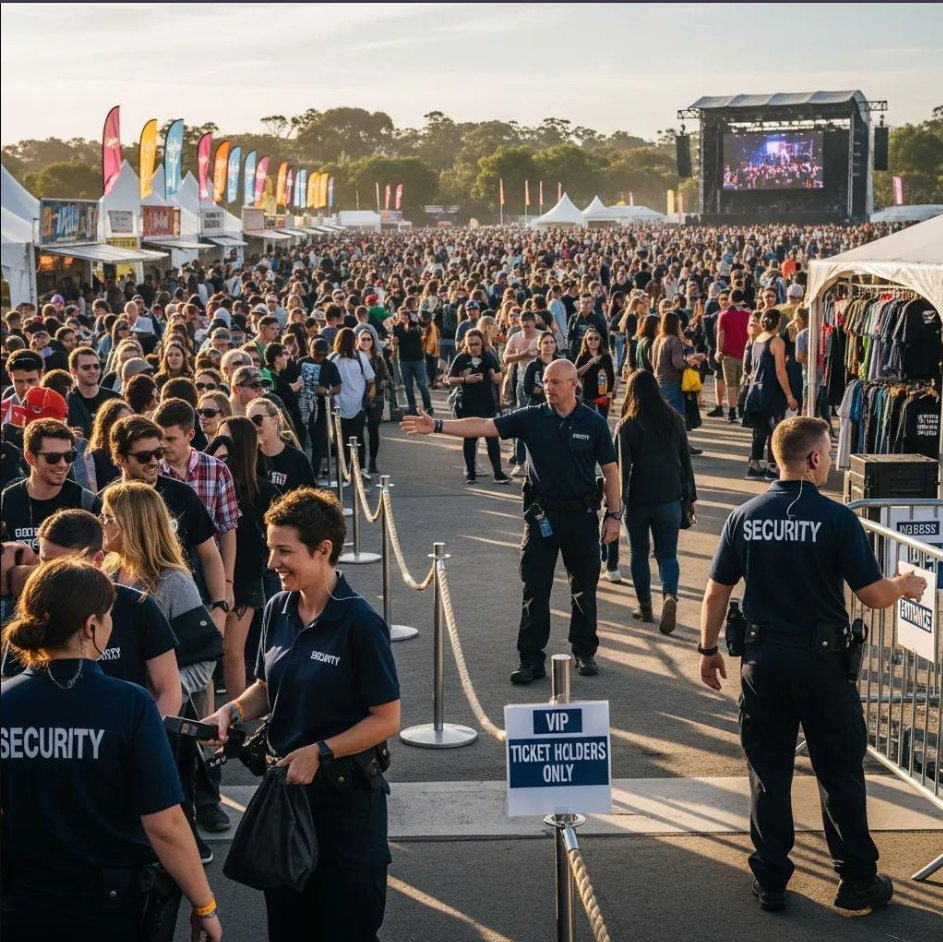
Effective crowd control combines infrastructure, staff patterns, and real-time monitoring. Designing ingress/egress with one-way circulation, barrier placement, and staggered entry reduces bottlenecks. Clear signage and consistent messaging guide attendees, while live communications reroute flows based on density. These tactics lower density peaks and improve egress efficiency.
- Timed entry and staggered admissions: Smooth queues and cut congestion.
- Credential lanes and verification: Speed checks and deter unauthorized entry.
- Barrier placement and stewarding: Channel movement and guide attendees.
These measures work together: timed entry eases arrival, credential lanes keep access moving, and barriers shape movement for integrated crowd management. Flow techniques include one-way circulation, timed ticketing, and zoning. Access controls like wristbands and turnstiles add layered verification.
How does coordination with emergency response teams improve event security?
Working with police, fire, and EMS creates shared protocols and mutual-aid plans, speeding escalation and resource allocation. Joint briefings align situational awareness and confirm staging areas. Shared communications and escalation thresholds ensure smooth handoffs, shortening response times. Regular joint exercises strengthen these relationships.
How are advanced technologies integrated into event security services?
Technology extends human capability by widening situational awareness and automating verification, best used with defined roles and privacy practices. AI-enabled surveillance flags density anomalies and suspicious behaviour; drones offer aerial views. Biometric or RFID credentialing speeds entry and improves audit trails. An ISOC-style command centre synthesizes feeds and dispatches teams. Policies for privacy, data retention, and device operation are crucial for Canadian regulations.
What role do surveillance systems and drones play in modern event security?
Fixed CCTV with AI analytics highlights crowd trends and hazards, enabling proactive dispatch. Drones provide aerial perspective for dispersion and perimeter breaches. Deployments must respect Canadian drone rules. Integrated cameras, analytics, and aerial assets shorten detection-to-dispatch timelines and improve situational awareness.
How is access control enhanced with biometric and credential verification?
Biometric tools (fingerprint/facial recognition), with consent and privacy safeguards, accelerate VIP/staff entry and create audit trails. RFID wristbands and two-factor credentialing balance convenience and security. Implementation includes credential issuance, checkpoints, and manual fallbacks. These systems reduce unauthorized access and shorten queues, requiring clear privacy policies.
What measurable outcomes demonstrate success in event security case studies?
Measurable outcomes show security effectiveness. Common KPIs include incident rate, response time, queue-time reduction, and attendee satisfaction. Baseline and post-event metrics quantify improvements. Data from incident logs, CCTV analytics, and surveys provide evidence. Examples include reductions in incident rate, response time, queue time, and unauthorized access. Sharing these justifies interventions and prioritizes investments.
How do metrics like incident reduction and crowd-flow improvement reflect security effectiveness?
Fewer incidents show effective prevention; faster response times reflect operational readiness. Crowd-flow metrics show ingress/egress performance. Translating KPI changes into practical stories helps stakeholders see ROI. Post-event debriefs comparing KPIs to targets refine configurations.
What best practices and lessons can be learned from Axion Security’s case studies?
Key takeaways include early, venue-specific risk assessment, frontline de-escalation training, and an ISOC combining human and technological monitoring. Replicable practices include clear credentialing, timed-entry plans, and formal coordination with public-safety partners. Consistent measurement and after-action reviews improve SOPs. These practices are most effective when implemented together.
How can event organizers benefit from professional private event security services in Vancouver?
Hiring professional private event securityreduces liability, protects the guest experience, and provides specialist skills. Discreet protection for high-profile guests, customized staffing, and credential systems allow organizers to focus on the program. Professional teams coordinate with venue management and public-safety agencies. These benefits lead to smoother operations and a better attendee experience.
What are the unique security needs of private and VIP events?
Private and VIP events demand confidentiality, strict access control, and a seamless guest journey, requiring discrete security. Needs include plainclothes teams, pre-cleared transit routes, advance venue sweeps, and tailored credential workflows. Risk assessments emphasize privacy and reputation protection. Careful planning ensures protection without intruding on the guest experience.
How does Axion Security ensure discreet and effective protection for high-profile clients?
Axion Securityuses low-profile deployments, plainclothes supervision, and advance route/venue checks to protect high-profile attendees. Our methods include coordination for secure staging, discreet entry, and transit contingency plans. A focus on professionalism, clear chain of command, and strict confidentiality ensures client privacy. Our team can advise on options.
Conclusion
Effective event securityimproves safety, reduces risk, and enhances the attendee experience. By combining venue-specific strategies, appropriate technology, and trained personnel, organizers can run smoother, safer events with measurable results. Understanding unique challenges allows for a tailored approach that protects people and reputation. Explore our services or contact our team for a consultation.